 admin
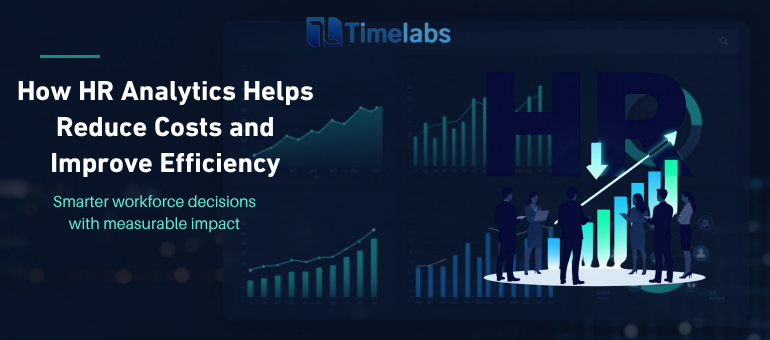
adminOrganisations across India are under growing pressure to do more with less. HR teams are expected to hire faster, reduce attrition, manage compliance, and demonstrate the value of every rupee spent on people. The challenge is that most of these decisions have historically been made on instinct, experience, or incomplete data. HR Analytics changes that. By turning workforce data into actionable insights, it gives HR leaders the evidence they need to make decisions that genuinely reduce costs and improve how the organisation operates.
This article covers how HR analytics contributes to cost reduction and operational efficiency across key areas of HR, including hiring, onboarding, training, and workforce planning.
Understanding the Cost Problem in HR
Where HR Costs Accumulate
HR costs are spread across the entire employee lifecycle. Hiring costs include job advertising, recruiter time, interview rounds, and background verification. Onboarding involves induction programs, documentation, equipment setup, and the time a new employee takes to become fully productive.
Training and development budgets are often allocated based on historical patterns rather than actual skill gaps. And attrition, one of the largest hidden costs in any organisation, generates recurring hiring and onboarding expenses every time a position is vacated and refilled.
The common factor across all of these is a lack of data-driven decision-making. When HR teams cannot see which interventions work, they continue spending on things that may not be delivering results.
Why Gut Feeling Is Not Enough
Many HR decisions are still made based on manager experience or industry benchmarks that may not reflect the organisation’s specific context. This approach works in stable environments, but breaks down when organisations scale rapidly, operate across multiple locations, or face high attrition in specific roles or departments.
Data provides the missing context. It shows which hiring channels produce candidates who stay longer, which managers have higher team attrition, and which training programs translate into measurable performance improvement. Without this visibility, cost reduction efforts are largely guesswork.
How HR Analytics Drives Cost Reduction
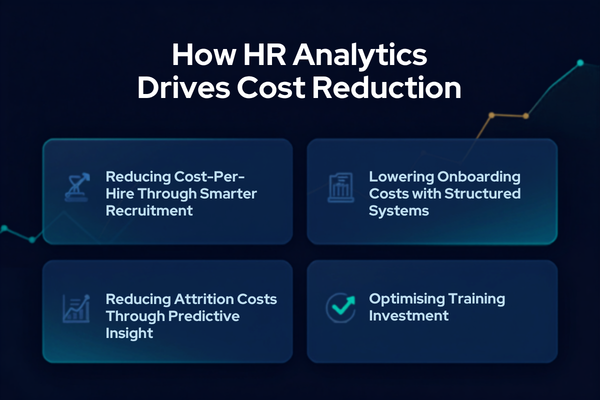
Reducing Cost-Per-Hire Through Smarter Recruitment
HR Analytics gives recruitment teams visibility into which sourcing channels, job boards, or referral programs produce the most qualified candidates at the lowest cost. By tracking application-to-hire ratios, time-to-fill, and post-hire performance across different sources, HR can reallocate recruitment spending toward the channels that consistently deliver results.
This data-led approach to recruitment reduces wasteful spending on underperforming channels and shortens time-to-fill, which in turn reduces the productivity loss caused by open positions.
Lowering Onboarding Costs with Structured Systems
Onboarding is one of the most process-intensive stages of the employee lifecycle. When it is managed manually, it involves significant HR time, repeated coordination between departments, and frequent delays in getting new hires access to systems, documents, and induction content.
Employee Onboarding Software removes the inefficiency from this process by automating task assignments, document collection, access provisioning, and induction scheduling. The result is a structured, consistent onboarding experience that costs less in HR time and gets new hires productive faster.
Analytics within the onboarding process can also measure how long each stage takes, identify bottlenecks, and flag when specific departments or managers are consistently slow in completing onboarding tasks for new team members.
Reducing Attrition Costs Through Predictive Insight
Replacing an employee costs anywhere between six months to a year of their salary when factoring in recruitment, onboarding, and the time taken to reach full productivity. Reducing attrition even marginally has a significant impact on total HR costs.
Analytics helps by identifying the early warning signals of disengagement before an employee decides to leave. Patterns such as increased absenteeism, declining performance scores, reduced participation in team activities, or a concentration of exits in a specific department or under a particular manager can all be surfaced through workforce data.
When HR teams can see these patterns early, they can intervene with targeted actions: a development conversation, a role adjustment, a manager coaching session, or a change in work arrangement. Each intervention costs far less than replacing the employee.
Optimising Training Investment
Training budgets are frequently distributed based on role category or historical precedent rather than actual skill needs. Learning & Development Solutions that are informed by analytics take a different approach. By connecting performance data, skill assessments, and role requirements, they identify where skill gaps genuinely exist and direct training resources to address those gaps specifically.
This means organisations stop spending on training that employees do not need and start investing in programs that directly address the capability gaps that are affecting performance, compliance, or customer outcomes.
How HR Analytics Improves Operational Efficiency
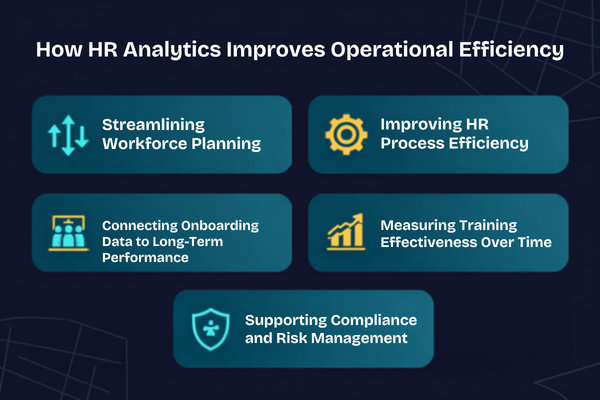
Streamlining Workforce Planning
HR Analytics supports more accurate workforce planning by analysing historical headcount data, business growth patterns, and departmental output to forecast future staffing needs. This allows HR to begin recruitment processes in advance of a vacancy rather than reacting to one, reducing the gap between a role opening and a qualified person filling it.
For organisations with seasonal demand cycles or project-based staffing needs, analytics also supports temporary workforce planning by identifying when and where contract or additional resources will be needed.
Improving HR Process Efficiency
Beyond workforce decisions, analytics also highlights inefficiencies within HR processes themselves. How long does it take to complete a performance review cycle? Which departments have the highest volume of leave policy exceptions? How many payroll corrections are raised each month, and what is causing them?
These process metrics help HR teams identify where their own operations are consuming disproportionate time and resources. Fixing these internal inefficiencies frees up HR bandwidth for strategic work and reduces the operational cost of running the HR function.
Connecting Onboarding Data to Long-Term Performance
Employee Onboarding Software that is integrated with the broader HRMS generates data that connects early employment experience with long-term outcomes. Organisations can analyse whether employees who completed a structured onboarding program within their first 30 days performed better at the six-month mark, or whether departments with lower onboarding completion rates experienced higher attrition in the first year.
Platforms like Timelabs connect onboarding with attendance, payroll, and performance data within a single HRMS, making it possible to draw these connections and use them to continuously improve the new hire experience.
Measuring Training Effectiveness Over Time
Learning & Development Solutions integrated with performance management systems allow HR to measure whether training programs are delivering measurable outcomes. After a team completes a compliance training, are audit findings reduced? After a management development program, do participating managers show lower attrition in their teams?
This kind of outcome measurement transforms training from a cost centre into a function with a demonstrable return on investment. It also gives L&D teams the evidence they need to justify program budgets to leadership.
Supporting Compliance and Risk Management
HR compliance failures carry financial penalties, legal risk, and reputational damage. Analytics helps reduce compliance risk by providing real-time visibility into areas such as attendance regulation adherence, overtime tracking, statutory filing timelines, and policy acknowledgement completion rates.
When Learning & Development Solutions are used to deliver mandatory compliance training, analytics can confirm completion rates across teams and locations, identify employees who have not completed required training, and generate audit-ready reports that demonstrate regulatory adherence.
Building a Data-Driven HR Function
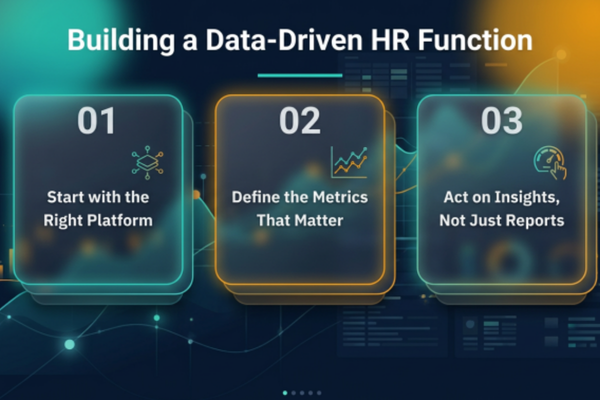
Start with the Right Platform
The foundation of any analytics capability is data quality. If HR data is fragmented across spreadsheets, separate payroll tools, and disconnected attendance systems, generating reliable analytics is difficult. The starting point is consolidating core HR functions on an integrated HRMS platform.
Employee Onboarding Software, payroll, attendance, leave, and performance modules that share a common data layer make it significantly easier to run cross-functional analysis. When all employee data flows into the same system, HR leaders can ask questions that span the entire employee lifecycle rather than being limited to one function at a time.
Timelabs HRMS brings together recruitment, onboarding, payroll, attendance, leave, performance, and analytics in a single platform built specifically for Indian businesses. This integrated data foundation is what enables meaningful HR analytics without the need for complex data engineering work.
Define the Metrics That Matter
Not all HR data is equally useful. Effective analytics starts by defining the metrics that connect directly to business outcomes: cost-per-hire, time-to-productivity, attrition rate by department, training completion versus performance improvement, and payroll cost as a percentage of revenue.
Once these metrics are defined, HR teams can build dashboards that surface the right information at the right time for the right audience, whether that is a monthly attrition summary for leadership or a real-time recruitment pipeline view for a hiring manager.
Act on Insights, Not Just Reports
Analytics only reduces costs and improves efficiency when it leads to action. Generating reports is not enough. HR teams need a process for reviewing analytics regularly, identifying the most significant findings, and making decisions or adjustments based on what the data shows.
This requires building analytics into existing HR planning cycles rather than treating it as a separate activity. When workforce planning, recruitment reviews, and training evaluations are all informed by data as a matter of routine, the organisation naturally becomes more efficient over time.
Must Read: How AI is Reshaping Talent Acquisition and Workforce Planning
Conclusion
HR analytics is not a tool for large enterprises with dedicated data science teams. It is a practical capability that any organisation can develop by choosing the right HR platform, defining the metrics that matter, and building the habit of making data-informed decisions.
The organisations that invest in this capability are reducing hiring costs, lowering attrition, improving training ROI, and running leaner HR operations. Those that continue to rely on intuition and historical practice will find it increasingly difficult to compete for talent and manage workforce costs effectively.
Timelabs provides Indian businesses with an integrated HRMS that connects payroll, attendance, recruitment, onboarding, learning, and performance in one platform, with built-in analytics that gives HR leaders the visibility they need to make decisions that genuinely move the needle on cost and efficiency.
Frequently Asked Questions (FAQs)
Q1. How does HR Analytics help reduce employee attrition costs?
Ans: HR Analytics identifies early indicators of disengagement by tracking patterns in attendance, performance, and leave data. When these signals are detected, HR teams can intervene before an employee decides to leave. Since replacing an employee costs significantly more than retaining one, even a modest reduction in attrition produces a measurable impact on total workforce costs.
Q2. What is the role of Employee Onboarding Software in improving efficiency?
Ans: Employee Onboarding Software automates the administrative tasks associated with bringing a new hire into the organisation, including document collection, task assignments, system access, and induction scheduling. This reduces the HR time spent on manual coordination, speeds up the time it takes for new employees to become productive, and creates a consistent experience regardless of which team or location the hire joins.
Q3. How can Learning and Development Solutions be made more cost-effective?
Ans: Learning and Development Solutions become more cost-effective when they are guided by analytics. Instead of assigning the same training program to an entire department, organisations can use performance data and skill assessments to identify where specific gaps exist and direct training resources accordingly. This prevents wasteful spending on programs that employees do not need and ensures that training budgets are focused on areas with a clear impact on outcomes.
Q4. What data does an HR analytics platform typically use?
Ans: An HR analytics platform draws on data from payroll records, attendance logs, leave history, recruitment metrics, performance review scores, training completion rates, and employee engagement surveys. When these data sets are held within an integrated HRMS, the platform can combine them to surface insights that would not be visible from any single source alone.
Q5. How does Timelabs support HR analytics for Indian businesses?
Ans: Timelabs HRMS integrates payroll, attendance, recruitment, onboarding, leave, performance, and learning data within a single platform. This shared data foundation makes it possible to run cross-functional analytics without manual data consolidation. Built-in dashboards and MIS reports give HR leaders and business managers visibility into key workforce metrics, supporting data-driven decisions on hiring, retention, training, and cost management.