 admin
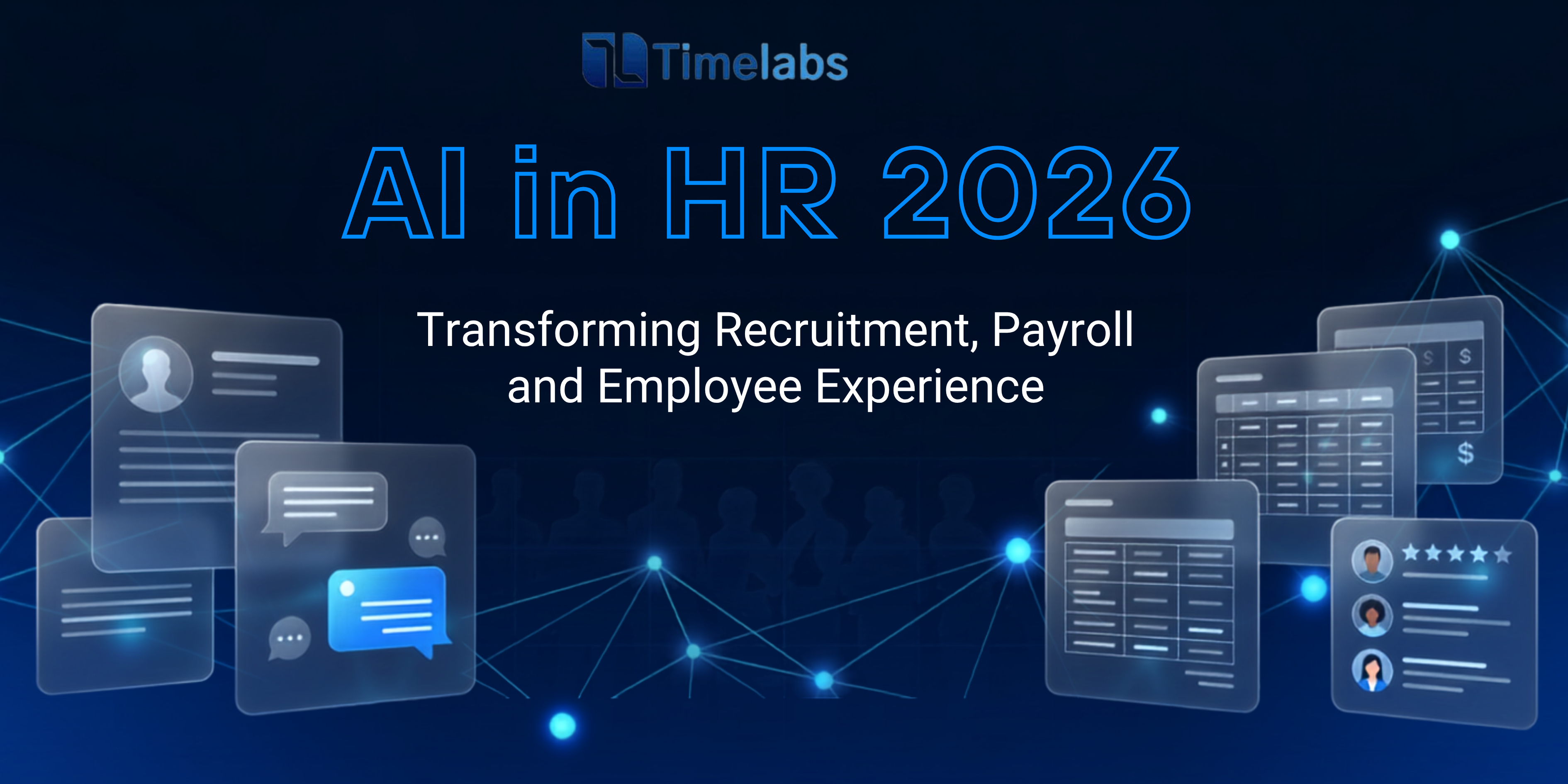
adminArtificial Intelligence is reshaping every function of HR in 2026. Across Indian businesses of all sizes, AI is being applied to speed up hiring, reduce payroll errors, and give employees more control over their own data. For organisations evaluating where to start, Recruitment Management Software has become one of the most impactful entry points into AI-driven HR transformation. It is no longer just a database for applications. It is an intelligent hiring engine that automates workflows, surfaces the right candidates, and connects seamlessly with the rest of the HRMS.
This article covers how AI is changing recruitment, payroll, and the employee experience in 2026 and what HR teams can do to stay ahead of the shift.
How AI is Changing Recruitment in 2026
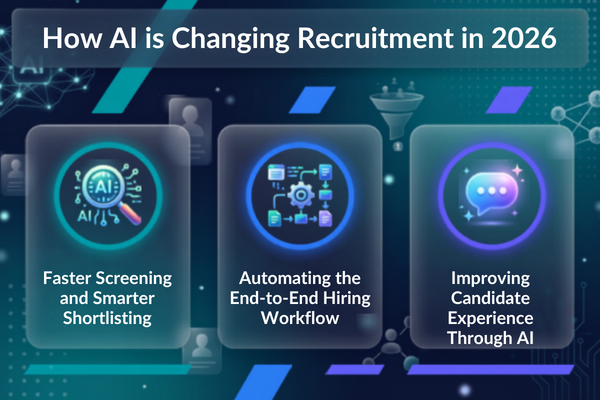
Faster Screening and Smarter Shortlisting
Reviewing hundreds of applications for a single role has always been one of the most time-intensive parts of HR work. AI changes this by scanning applications against defined job criteria, scoring candidates on relevance, and surfacing the most suitable profiles automatically.
This does not replace human judgment. It sharpens it. HR teams spend less time on initial screening and more time in meaningful conversations with candidates who genuinely fit the role. AI also identifies patterns in successful past hires and uses that data to guide future shortlisting.
Automating the End-to-End Hiring Workflow
Recruitment Management Software in 2026 covers the entire hiring journey, not just application tracking. From job requisition approval and job board distribution to candidate communication, interview scheduling, offer generation, and pre-boarding handoffs, the platform handles the workflow automatically.
Hiring managers can review candidate pipelines, leave structured feedback, and approve decisions within the same system. This eliminates the fragmented mix of emails, spreadsheets, and separate tools that slows down hiring in many organisations.
Timelabs recruitment module connects hiring workflows with onboarding, attendance, and payroll. Once a candidate is selected and an offer is accepted, their data moves into the HR system without any manual re-entry, reducing errors from the very first day of employment.
Improving Candidate Experience Through AI
AI also improves the experience for job applicants. Chatbots answer candidate queries at any hour, automated messages keep applicants informed of their status, and interview slots are confirmed without back-and-forth emails. A well-configured Recruitment Management Software platform ensures that every candidate interaction is timely and professional, which directly reflects on the organisation’s employer brand.
For high-volume hiring in sectors like manufacturing, retail, or logistics, this level of automation is essential. Without it, the process becomes unmanageable at scale.
AI and Payroll: Accuracy, Compliance and Efficiency
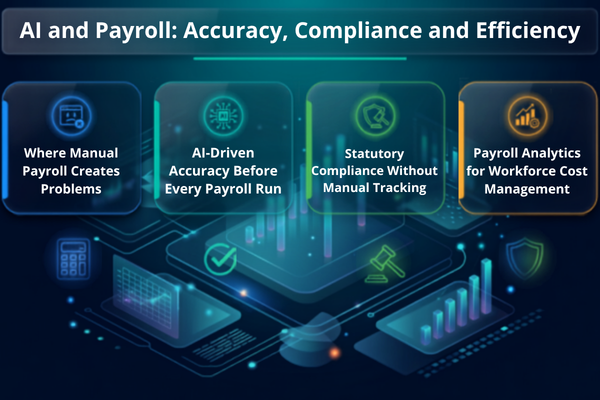
Where Manual Payroll Creates Problems
Payroll errors are costly, both financially and in terms of employee trust. Incorrect tax deductions, attendance data mismatches, missed reimbursements, and late statutory filings are all common in organisations that still rely on manual or semi-automated payroll processes.
For large or geographically distributed workforces, these problems compound quickly. Each error requires investigation, correction, and communication, consuming time that HR and finance teams cannot afford to lose every pay cycle.
AI-Driven Accuracy Before Every Payroll Run
AI-driven Payroll Software in India validates data before each payroll run, checking for anomalies like attendance mismatches, duplicate entries, or unusual deduction patterns. Issues are flagged for review before salaries are processed, not discovered after the fact.
This pre-processing step significantly reduces the volume of errors that reach the final payslip and shortens the time HR teams spend reconciling data before payroll closure.
Statutory Compliance Without Manual Tracking
Payroll Software in India built for Indian compliance handles PF, ESI, TDS, professional tax, Labour Welfare Fund, and bonus calculations within a single platform. When rates change or new statutory rules are introduced, a well-maintained system updates its calculation engine accordingly.
Timelabs payroll module covers PF, ESI, TDS, professional tax, Form 16 generation, and payslip distribution, all within a single integrated HRMS. This removes the need for separate tools for each obligation and ensures that every calculation is consistent and ready for audit.
Payroll Analytics for Workforce Cost Management
Payroll Software in India with built-in analytics gives finance teams visibility into payroll cost trends, department-wise salary distribution, and the projected impact of increments. This data supports informed decisions on compensation budgets, headcount planning, and year-on-year cost management across the organisation.
Improving Employee Experience with Self-Service
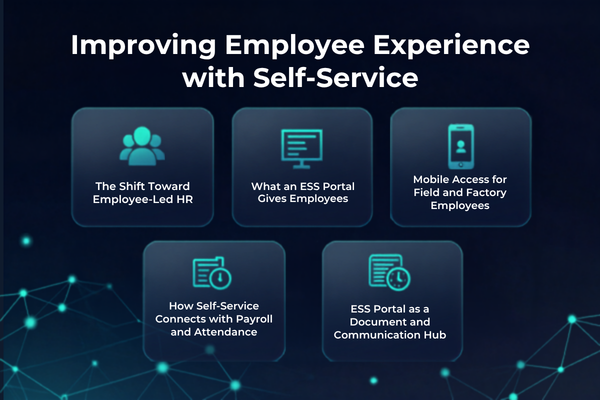
The Shift Toward Employee-Led HR
The traditional HR model relies on employees submitting requests and HR teams processing them. This creates delays, generates repeat queries, and ties up HR bandwidth on tasks that could be handled by employees themselves with the right tools.
In 2026, organisations are investing in self-service technology that puts routine HR interactions directly in the hands of employees. The result is faster resolution of common requests, higher employee satisfaction, and more time for HR to focus on strategic work.
What an ESS Portal Gives Employees
An ESS Portal provides employees with a dedicated interface to manage their own HR data and requests. Through the portal, employees can view and download payslips, check leave balances, apply for leave, update personal and bank details, submit investment declarations, access Form 16 and tax documents, and raise HR queries, all independently and in real time.
For HR teams, this significantly reduces the volume of routine queries and allows the department to redirect its attention toward talent development, compliance management, and workforce planning.
Mobile Access for Field and Factory Employees
Employee Self Services are especially valuable when delivered through a mobile application. Employees in the field, on the factory floor, or working across multiple locations can mark attendance via GPS-enabled check-in, apply for leave on the move, raise reimbursement claims, and receive approval notifications in real time without needing office access.
This makes the HR system equally accessible for desk-based and non-desk employees, closing the gap that often exists between corporate HR processes and the daily reality of frontline workers.
How Self-Service Connects with Payroll and Attendance
Employee Self Services only deliver their full value when they are integrated with the payroll and attendance systems behind them. When an employee updates their bank details through the portal, that change should reflect in payroll automatically. When leave is approved, it should adjust the attendance record and feed into the next salary run without any manual step by HR.
Timelabs ESS portal is integrated with payroll, leave, and attendance modules within the HRMS. Employee-initiated actions update connected systems in real time, eliminating manual syncing and reducing the risk of data discrepancies between HR records and payslip calculations.
ESS Portal as a Document and Communication Hub
An ESS Portal is also a practical channel for distributing HR documents and collecting digital acknowledgements. Offer letters, appraisal letters, policy updates, and compliance notices can be sent through the portal and acknowledged by employees with a digital signature, creating an auditable record without any paper trail.
For organisations that are scaling rapidly or managing a distributed workforce, a well-configured ESS Portal standardises how HR information is communicated and ensures that every employee, regardless of location, receives consistent and timely updates.
What HR Teams Should Prioritise in 2026
Across recruitment, payroll, and employee experience, the organisations moving forward fastest share a common foundation: integrated HR technology that connects these functions rather than running them in isolation.
Key priorities for HR teams this year:
- Audit current hiring workflows and evaluate whether your recruitment platform supports AI-assisted screening and end-to-end automation
- Ensure payroll software is current on Indian statutory requirements and can handle revised wage definitions under the Labour Codes
- Deploy mobile self-service to employees across all work types, including field, factory, and remote staff
- Connect recruitment, payroll, attendance, and self-service within a single HRMS to eliminate data silos
- Use HR analytics to monitor hiring quality, payroll cost trends, and employee self-service adoption rates
Conclusion
AI in HR is not a single product or feature. It is an approach to running HR that is faster, more accurate, and better informed by data. In 2026, the organisations benefiting most from AI are those that have moved beyond standalone tools and invested in connected platforms that bring recruitment, payroll, and employee experience together.
Timelabs provides a comprehensive HRMS covering recruitment, payroll, attendance, leave, employee self-service, and analytics within a single platform built for Indian businesses. If your organisation is still managing HR across disconnected tools and manual processes, now is the right time to evaluate what an integrated system can deliver.
Must Read: Labour Codes 2026 Compliance Checklist for Indian Businesses
Frequently Asked Questions (FAQs)
Q1. How does AI improve the recruitment process in 2026?
Ans: AI improves recruitment by automating resume screening, scoring candidate relevance against job requirements, scheduling interviews, and sending real-time application updates. Recruitment Management Software with AI capabilities reduces manual effort for HR teams, shortens time-to-hire, and improves the consistency and quality of hiring decisions across the organisation.
Q2. What should Indian businesses look for in Payroll Software?
Ans: Indian businesses should look for payroll software that handles all statutory deductions, including PF, ESI, TDS, professional tax, and Labour Welfare Fund, and that updates automatically when rates or rules change. It should integrate with attendance and leave systems for accurate calculations, generate payslips and Form 16 automatically, and support the new wage definitions being introduced under the Labour Codes 2026.
Q3. What tasks can employees complete through an ESS Portal?
Ans: Through an ESS Portal, employees can view and download payslips, check and apply for leave, update personal and bank details, submit investment declarations for tax purposes, access Form 16 and other HR documents, and raise queries or requests directly with HR. All of these tasks are completed by the employee without HR needing to intervene, reducing query volumes and improving resolution speed.
Q4. How do Employee Self Services help non-desk workers?
Ans: Employee Self Services delivered through a mobile application allow factory workers, field staff, and employees at remote locations to mark attendance via GPS check-in, apply for leave or submit expense claims from anywhere, and receive approval notifications in real time. This makes HR processes equally accessible to all employees, not just those working at a desk.
Q5. Why is integrating ESS Portal with payroll important?
Ans: Integrating the ESS Portal with payroll ensures that employee-initiated changes, such as bank detail updates, investment declarations, or leave applications, are automatically reflected in payroll calculations without any manual step by HR. This reduces data errors, speeds up payroll processing, and ensures that every employee’s salary is calculated on accurate and current information.