 admin
adminManaging payroll is one of the most critical and complex responsibilities in any organisation. From calculating salaries and deductions to filing statutory returns on time, even a small error can result in heavy penalties or legal trouble. This is exactly why businesses today are turning to Payroll Software to automate and streamline payroll operations. Automated payroll not only saves time but also plays a major role in reducing compliance risks that companies face on a daily basis.
Understanding Compliance Risks in Payroll
Compliance in payroll goes far beyond just paying employees on time. It involves accurately calculating provident fund contributions, professional tax, employee state insurance, TDS deductions, and ensuring timely submission of reports to government authorities. Businesses that handle these processes manually are always at risk of missing deadlines, making calculation errors, or applying incorrect tax rates.
Non-compliance can result in financial penalties, reputational damage, and even legal consequences. Small and medium-sized businesses are especially vulnerable because they often lack a dedicated compliance team. This is where automated payroll systems step in to fill the gap and protect businesses from costly mistakes.
How Automated Payroll Software Minimises Compliance Risks
Modern Payroll Software is built to handle all compliance-related tasks automatically. Here is how it makes a real difference:
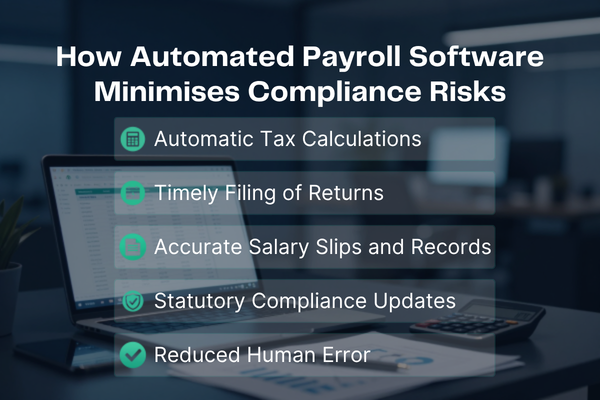
1. Automatic Tax Calculations
One of the biggest compliance challenges for businesses is keeping up with changing tax rates and rules. Automated payroll systems are regularly updated with the latest tax slabs, TDS rules, and statutory requirements. This means every salary calculation reflects the current legal requirements without any manual intervention.
2. Timely Filing of Returns
Missing deadlines for PF, ESI, or TDS filings can attract significant penalties. Payroll automation tools come with built-in reminders and scheduling features that ensure returns are prepared and submitted on time, every month. This eliminates the risk of forgetting critical compliance dates.
3. Accurate Salary Slips and Records
Payroll systems generate detailed, error-free salary slips that clearly mention all deductions and contributions. Maintaining accurate payroll records is a legal obligation, and automated systems ensure that every record is stored systematically and can be retrieved whenever required during audits.
4. Statutory Compliance Updates
Labour laws and statutory requirements change from time to time. A reliable payroll platform is regularly updated to reflect these changes, so your business always remains compliant without having to track every regulatory update manually.
5. Reduced Human Error
Manual payroll processes are prone to data entry errors, formula mistakes, and incorrect calculations. Automation virtually eliminates these risks by processing data consistently and accurately, following predefined rules every single time.
Why Payroll Software in India is a Growing Need
India has a complex statutory framework that includes the Employees Provident Fund Act, the Employees State Insurance Act, the Payment of Gratuity Act, the Minimum Wages Act, and various state-specific regulations. Managing compliance under all these laws manually is an enormous challenge for HR and finance teams.
Payroll Software in India is specifically designed to handle these local statutory requirements. It takes into account state-specific professional tax slabs, different minimum wage structures across states, and the latest EPFO or ESIC circulars. Businesses operating across multiple states particularly benefit from such region-aware payroll solutions.
The rise of remote working has further added to the complexity of payroll in India, as employees may be based in different states with different tax and compliance obligations. An automated system removes the guesswork from this process and ensures that each employee is managed accurately under the applicable laws of their respective state.
The Role of HR Software in Ensuring Compliance
Payroll compliance does not exist in isolation. It is closely linked to attendance tracking, leave management, and employee data management, all of which fall under the domain of HR Software. When payroll and HR functions work in an integrated manner, the data flowing between them is accurate and consistent, which directly supports compliance.
For example, accurate attendance records ensure that salary calculations reflect actual working days, overtime, and leave without pay. Leave data impacts payroll output directly. When HR and payroll systems are integrated, there is no need for manual data transfer, which eliminates a major source of errors.
Benefits of Integrated HR and Payroll Systems
- Centralised employee data with no duplication
- Automatic syncing of attendance and leave data with payroll
- Audit trail for all changes made to employee records
- Real-time visibility into payroll costs and compliance status
- Faster resolution of employee queries with self-service portals
How Timelabs Helps Businesses Stay Compliant
Timelabs is a trusted name in workforce management and payroll automation. Its payroll module is designed to handle the end-to-end payroll process, from salary calculation to statutory filings, with minimal manual effort. Timelabs ensures that businesses remain compliant with all applicable Indian labour laws and tax regulations.
With Timelabs, businesses can automate PF, ESI, PT, and TDS calculations, generate statutory reports in the required formats, and maintain comprehensive audit-ready records. Its cloud-based platform is regularly updated to incorporate the latest regulatory changes, so you never have to worry about being out of compliance.
Whether you are a startup, a growing mid-size company, or a large enterprise, Timelabs offers scalable payroll and HR solutions that adapt to your specific needs and help you avoid the risks that come with manual payroll management.
Key Features to Look for in a Payroll Compliance Tool
When choosing a payroll automation solution, here are the features that matter most for compliance:
- Statutory compliance coverage: Supports PF, ESI, TDS, PT, LWF, and gratuity calculations
- Automatic updates: System updates with every change in tax rates or labour laws
- Multi-state support: Handles different state-specific professional tax slabs
- Report generation: Produces ECR, Form 16, Form 24Q, and other statutory reports
- Audit trail: Maintains a complete history of payroll changes
- Employee self-service: Allows employees to view payslips and tax documents anytime
- Integration capability: Connects seamlessly with attendance and leave management systems
The Cost of Non-Compliance vs. Investment in Automation
Many businesses hesitate to invest in payroll software because they see it as an unnecessary cost. However, the financial and reputational damage caused by non-compliance far outweighs the cost of a good payroll system.
Penalties for late PF filings, TDS defaults, or incorrect ESI contributions can run into thousands or even lakhs of rupees. Add to that the cost of interest on delayed payments, legal fees in case of disputes, and the damage to employee morale when salaries are processed incorrectly, and the case for automation becomes very clear.
Investing in robust HR Software and payroll automation is not just a technology decision. It is a risk management strategy that protects your business, your employees, and your reputation.
Real-World Impact of Payroll Automation on Compliance
Companies that have adopted automated payroll solutions report significant reductions in compliance-related errors and penalties. HR teams spend less time on manual data entry and more time on strategic activities. Finance teams gain better visibility into payroll costs and liabilities.
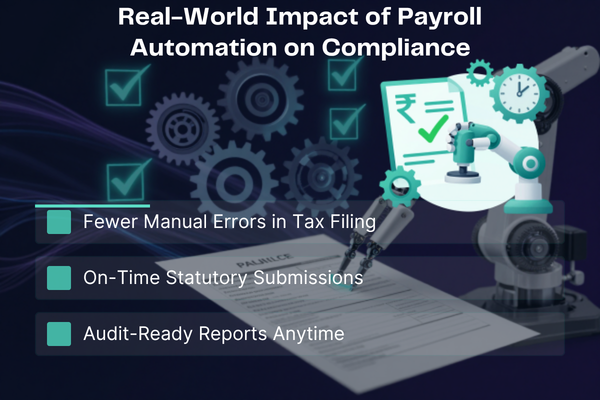
With Payroll Software in India like the one offered by Timelabs, businesses can generate provident fund challans, ESI returns, and TDS certificates with just a few clicks. What used to take days of manual work is now completed in minutes, with far greater accuracy.
The reduction in payroll processing time also frees up resources that can be redirected to business growth activities. For growing organisations, this efficiency gain is a significant competitive advantage.
Conclusion
Payroll compliance is not optional. It is a legal requirement that every business must take seriously, regardless of size or industry. Relying on manual processes in today is complex regulatory environment is a risk that no business can afford to take.
Automated Payroll Software eliminates the guesswork, reduces the chance of errors, and ensures that your business stays compliant with all applicable laws at all times. Paired with a strong HR Software platform, it creates a seamless, accurate, and audit-ready payroll process.
Timelabs brings together the power of payroll automation and HR management in a single, integrated platform designed specifically for Indian businesses. If you want to protect your business from compliance risks and run payroll with confidence, it is time to make the switch to automation.
Must Read: How HR Analytics Helps Reduce Costs and Improve Efficiency
Frequently Asked Questions (FAQs)
Q1. What are the main compliance risks in payroll management?
Ans: The main compliance risks include incorrect TDS deductions, late filing of PF or ESI returns, miscalculation of professional tax, non-adherence to minimum wage rules, and failure to issue Form 16 on time. All of these can lead to penalties and legal notices from government authorities.
Q2. How does Payroll Software in India handle state-specific compliance?
Ans: Payroll Software in India is built to manage state-specific variations in professional tax slabs, minimum wages, and labour welfare fund contributions. This ensures that employees located in different states are paid and taxed accurately according to the laws of their respective states.
Q3. Can HR Software help with payroll compliance?
Ans: Yes. HR Software that integrates with payroll ensures that attendance, leave, and employee data are always accurate and up to date. This data directly impacts payroll calculations, so integration reduces errors and supports compliance at every step.
Q4. Is Timelabs suitable for small businesses?
Ans: Timelabs offers scalable solutions that are suitable for businesses of all sizes, including small and medium enterprises. Its user-friendly interface and automated compliance features make it easy for small businesses to manage payroll without needing a large HR or finance team.
Q5. How often is payroll compliance software updated?
Ans: A reliable payroll solution like the one offered by Timelabs is updated regularly to reflect the latest changes in tax rates, labour laws, and statutory requirements. This ensures that your payroll processes are always aligned with current regulations without any manual effort on your part.